10 questions · Four answers, and only one is true. Can you spot it?
-
Question 1 of 10
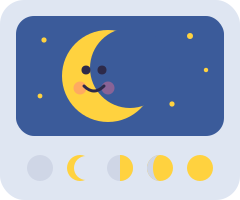
Why does the Moon change shape?
-
The Moon changes shape in the same way on a perfectly clear night.
-
The Sun always lights one half; we just look at that half from a new angle as it circles us.
-
Earth's shadow only touches the Moon on the rare night of an eclipse.
-
It is exactly the same round ball every night of the year.
Show the answer
- A The Moon changes shape in the same way on a perfectly clear night.
- B The Sun always lights one half; we just look at that half from a new angle as it circles us.
- C Earth's shadow only touches the Moon on the rare night of an eclipse.
- D It is exactly the same round ball every night of the year.
Read the story →
-
Question 2 of 10

Why do astronauts float in a spaceship?
-
Around the Earth. When everything falls at once, nothing presses on anything — and that feels like floating.
-
They weigh exactly what they weigh; nothing about them changed.
-
Air cannot hold up a person, in space or anywhere else.
-
Gravity is still tugging on them — it is what keeps them going round the Earth.
Show the answer
- A Around the Earth. When everything falls at once, nothing presses on anything — and that feels like floating.
- B They weigh exactly what they weigh; nothing about them changed.
- C Air cannot hold up a person, in space or anywhere else.
- D Gravity is still tugging on them — it is what keeps them going round the Earth.
Read the story →
-
Question 3 of 10

Why is it warm when the Sun shines on you?
-
There is no air between us and the Sun for it to blow.
-
The Sun stays about the same distance away all year long.
-
There it turns into warmth. Light can fly through empty space, and what it delivers is energy.
-
A torch is bright too, and its light is cool on your hand.
Show the answer
- A There is no air between us and the Sun for it to blow.
- B The Sun stays about the same distance away all year long.
- C There it turns into warmth. Light can fly through empty space, and what it delivers is energy.
- D A torch is bright too, and its light is cool on your hand.
Read the story →
-
Question 4 of 10
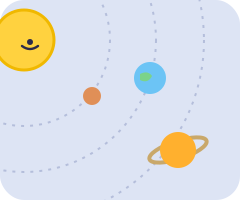
What are the planets?
-
Earth among them. A year on Mercury is 88 days; on faraway Neptune, 165 of ours.
-
Earth has one moon; the planets circle the Sun.
-
A planet makes no light of its own — a star does.
-
They are eight very different worlds, from scorched rock to rings of ice.
Show the answer
- A Earth among them. A year on Mercury is 88 days; on faraway Neptune, 165 of ours.
- B Earth has one moon; the planets circle the Sun.
- C A planet makes no light of its own — a star does.
- D They are eight very different worlds, from scorched rock to rings of ice.
Read the story →
-
Question 5 of 10
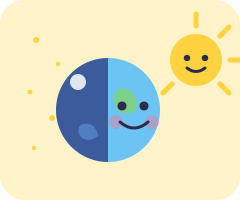
Why do we have day and night?
-
It only looks that way — it is we who are moving, not the Sun.
-
The Sun shines all the time — it is shining on someone right now.
-
The other is turned away into shadow. One whole spin takes about 24 hours, and that is one day.
-
Night comes on perfectly clear evenings too.
Show the answer
- A It only looks that way — it is we who are moving, not the Sun.
- B The Sun shines all the time — it is shining on someone right now.
- C The other is turned away into shadow. One whole spin takes about 24 hours, and that is one day.
- D Night comes on perfectly clear evenings too.
Read the story →
-
Question 6 of 10

What is a star?
-
That would be a planet or a moon; a star makes its own light.
-
Stars shine all day too; the bright sky hides them.
-
It makes its own light and heat — our Sun is one, and looks huge only because it is so near.
-
Each one is a sun of its own.
Show the answer
- A That would be a planet or a moon; a star makes its own light.
- B Stars shine all day too; the bright sky hides them.
- C It makes its own light and heat — our Sun is one, and looks huge only because it is so near.
- D Each one is a sun of its own.
Read the story →
-
Question 7 of 10
Why can't we see the stars in the daytime?
-
The stars are still there — point a telescope at the right spot and you can find one even at noon.
-
A star burns on for billions of years without a pause.
-
It is the other way round: the bright blue air is in front.
-
They only look as though they move, because Earth is turning.
Show the answer
- A The stars are still there — point a telescope at the right spot and you can find one even at noon.
- B A star burns on for billions of years without a pause.
- C It is the other way round: the bright blue air is in front.
- D They only look as though they move, because Earth is turning.
Read the story →
-
Question 8 of 10
What are shooting stars?
-
They rush into our air and glow; most are no bigger than a pea, yet they light up the whole sky.
-
A star is a colossal sun, far too far away to fall on us.
-
A plane's lights blink and cross the sky slowly.
-
Shooting stars are best seen on clear nights with no storm at all.
Show the answer
- A They rush into our air and glow; most are no bigger than a pea, yet they light up the whole sky.
- B A star is a colossal sun, far too far away to fall on us.
- C A plane's lights blink and cross the sky slowly.
- D Shooting stars are best seen on clear nights with no storm at all.
Read the story →
-
Question 9 of 10
What is the Moon made of?
-
The Moon makes no light — it only holds up the Sun's, like a mirror.
-
A lovely idea, but astronauts brought back rock, not cheese.
-
That dry dust is why footprints up there last for millions of years.
-
A little ice hides in its coldest corners, but the Moon is rock.
Show the answer
- A The Moon makes no light — it only holds up the Sun's, like a mirror.
- B A lovely idea, but astronauts brought back rock, not cheese.
- C That dry dust is why footprints up there last for millions of years.
- D A little ice hides in its coldest corners, but the Moon is rock.
Read the story →
-
Question 10 of 10
What is gravity?
-
Every object pulls; the Moon and the Sun have it too.
-
Stronger the bigger they are — it holds us down and keeps the Moon with us. Up there you could jump about six times higher.
-
Take the air away and you still fall.
-
A feather is pulled just as surely — the air merely slows it.
Show the answer
- A Every object pulls; the Moon and the Sun have it too.
- B Stronger the bigger they are — it holds us down and keeps the Moon with us. Up there you could jump about six times higher.
- C Take the air away and you still fall.
- D A feather is pulled just as surely — the air merely slows it.
Read the story →
