7 questions · Four answers, and only one is true. Can you spot it?
-
Question 1 of 7

How does a mirror work?
-
Step aside and your reflection leaves instantly.
-
It keeps the picture in order; a rough surface bounces light too, but scatters it, so you see no reflection.
-
In a dark room a mirror shows nothing.
-
It shows whatever comes along, including things it has never seen before.
Show the answer
- A Step aside and your reflection leaves instantly.
- B It keeps the picture in order; a rough surface bounces light too, but scatters it, so you see no reflection.
- C In a dark room a mirror shows nothing.
- D It shows whatever comes along, including things it has never seen before.
Read the story →
-
Question 2 of 7
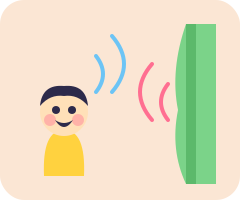
Why do we hear echoes?
-
Echoes answer in empty valleys and caves where nobody is.
-
Nothing is stuck — it has travelled there and back.
-
You would hear everything twice everywhere, which you do not.
-
It comes back a moment later, and that wait is what makes it a separate sound instead of your voice.
Show the answer
- A Echoes answer in empty valleys and caves where nobody is.
- B Nothing is stuck — it has travelled there and back.
- C You would hear everything twice everywhere, which you do not.
- D It comes back a moment later, and that wait is what makes it a separate sound instead of your voice.
Read the story →
-
Question 3 of 7

What makes music?
-
An instrument makes sound; the pattern makes it music.
-
A drum and a flute make music with no words at all.
-
Something shakes fast for a high note, slowly for a low one — a string, a drum skin, a column of air.
-
A slammed door is loud, and it is not music.
Show the answer
- A An instrument makes sound; the pattern makes it music.
- B A drum and a flute make music with no words at all.
- C Something shakes fast for a high note, slowly for a low one — a string, a drum skin, a column of air.
- D A slammed door is loud, and it is not music.
Read the story →
-
Question 4 of 7
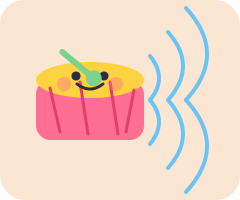
What is sound?
-
It reaches your ears as a wiggle — and with no air, there is no sound at all.
-
A slammed door is not alive and is very loud.
-
Light needs no air; sound cannot manage without it.
-
The air stays where it is; only the wiggle travels.
Show the answer
- A It reaches your ears as a wiggle — and with no air, there is no sound at all.
- B A slammed door is not alive and is very loud.
- C Light needs no air; sound cannot manage without it.
- D The air stays where it is; only the wiggle travels.
Read the story →
-
Question 5 of 7

How do we hear sounds?
-
Three tiny ones — the smallest is tinier than a grain of rice — and then the brain reads the signals.
-
There is a whole little machine in the way.
-
Your brain does the understanding, at the very end.
-
The ear passes the sound on and turns it into signals.
Show the answer
- A Three tiny ones — the smallest is tinier than a grain of rice — and then the brain reads the signals.
- B There is a whole little machine in the way.
- C Your brain does the understanding, at the very end.
- D The ear passes the sound on and turns it into signals.
Read the story →
-
Question 6 of 7

Why do things have colour?
-
It soaks up the rest. Something black bounces back almost nothing, which is why it gets so hot.
-
A leaf has no paint on it at all.
-
The Sun shines the same white light on all of them.
-
Your eyes catch the colour; the thing decides which one.
Show the answer
- A It soaks up the rest. Something black bounces back almost nothing, which is why it gets so hot.
- B A leaf has no paint on it at all.
- C The Sun shines the same white light on all of them.
- D Your eyes catch the colour; the thing decides which one.
Read the story →
-
Question 7 of 7

What is a shadow?
-
Stand in the dark and you make no shadow at all.
-
Nothing is there — it is a shape of missing light.
-
A reflection shows your face; a shadow shows only your outline.
-
Light travels in straight lines, so your outline is left behind unlit.
Show the answer
- A Stand in the dark and you make no shadow at all.
- B Nothing is there — it is a shape of missing light.
- C A reflection shows your face; a shadow shows only your outline.
- D Light travels in straight lines, so your outline is left behind unlit.
Read the story →
